






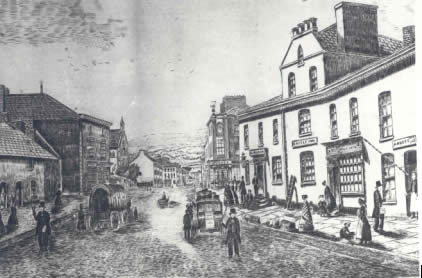
Merthyr Tydfil finally became a County Borough on the 1st April 1908, following a staggering sixty eight years of attempts to petition Parliament for a Charter of Incorporation. In 1907, Merthyr Tydfil Borough Council applied to the Home Secretary, Herbert John Gladstone, for permission to maintain a separate police force under the control of the Merthyr Tydfil Watch Committee. Gladstone agreed, providing it was the wish of the inhabitants, given the size and importance of Merthyr Tydfil during this period.
Previously Merthyr Tydfil had formed part of the "A" Division of Glamorgan County Constabulary, who had been responsible for policing this heavily industrial part of Glamorgan since October 1841. Out of a force of 34 men, 12 were posted to Merthyr Tydfil and Dowlais. Although this may appear to be a woefully inadequate number to us today, this was a period in history in which no more than one constable was allocated to a town!
Policing Merthyr Tydfil was an arduous task - in the 70 years since the first iron furnace had been erected in the district, the town had developed from a hamlet inhabited by shepherds and farmers to a sprawling mass of inelegant buildings housing a population three times as great as that of Cardiff and Swansea put together. In 1840, the much travelled geologist, De La Beche, described the growth of Merthyr as more rapid than that of any town in the USA!
The Industrialisation of Merthyr Tydfil
In 1790 no High Street existed, nor any building in the locality of the present town centre, except a small cottage, and the principal inn was the "Bwthyn" later "The Farmers Arms" near Morlais bridge. The main reason for the expansion of the town from this time onwards was the demand for greater iron production created by the Napoleanic wars, but this could not be exploited to the full until there existed a better means of transport between Merthyr and the ports of Cardiff and Newport than the old system of pack horses along old mountain tracks.
The track down the valley was converted into a turnpike road by the iron masters, but road transport by pack horse, even over the new road, proved too expensive. The animals used to carry about 130 pounds of iron, a train of three or four at a time being driven by a woman or a boy.
A canal between Merthyr and Cardiff presented many problems, for in a distance of about 25 miles there was a fall of about 510 feet between Merthyr and the sea, and the terrain demanded prodigious labour. 50 locks would be needed, 16 of them between Abercynon and Quakers Yard, a distance of only 2 or 3 miles, but where there was a fall of 200 feet. The end, however, justified the cost, and the Glamorganshire Canal was completed between Cardiff and Abercynon by 1794, but it took another 4 years to complete the nine miles between Abercynon and Merthyr.
The canal passed the Plymouth works and terminated at the famous Cyfarthfa furnaces, giving these a decided advantage over the more distant works at Penydarren and Dowlais, the owners of which decided to provide their own means of communication with the sea by a tramway from Dowlais to Cardiff. This scheme was only partly carried out, getting as far as Abercynon, but it did enable iron from the Dowlais and Penydarren works to be carried on horse-drawn trams to Abercynon, thus avoiding the most tortuous part of the canal route, and to permit the cargo to be transferred to canal barges there. The rivalry between the iron masters and the extent of their need to improve transport facilities is evidenced by the attempt to use a steam engine on rails nearly 40 years before the first railway was driven up the valley!
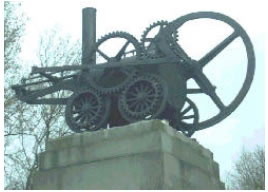
The Trevithick Memorial - The Penydarren Locomotive
Homfray (Penydarren) boasted of his ability to run steam engines on his tramway to Abercynon much more efficiently than the barges could operate on the canal. A bet of 1000 guineas was made and tremendous interest was aroused locally. The steam locomotive was built by Trevethick, a Cornish engineer employed by Homfray. The steam engine had to pull 10 tons of iron and 70 men from Merthyr to Abercynon on February 14th 1804. Despite a mishap where the chimney of the locomotive struck a low bridge , demolishing the chimney and the bridge, and resulting in emergency repair work, the train did eventually reach Abercynon. However, the engine failed to make the return journey up the steep gradients to Merthyr, despite now having no load to pull, and it was not until the 1830s with the advent of more powerful engines that the railway connection between Merthyr and Cardiff became possible. The famous Taff Vale Railway was not completed until 1841.
It was the rapid development of the railways both in Great Britain and abroad, that created a demand for iron that even constant extensions of the iron works could not completely satisfy. High wages had to be offered to attract workmen from far afield, for local labour could not meet the demands of the iron works and the collieries on which they depended. A constant stream of employment seekers were draw to Merthyr Tydfil from all parts of Britain and the continent. However, there was not enough work for everyone and many hundreds of people, unable or unwilling to return to whence they came, stayed on in the hope of a change in their fortune, only to be forced to resort to begging, thieving and lawlessness to eke out a living. In addition, professional vagrants, beggars, bullies, thieves, swindlers and prostitutes were also attracted to Merthyr to prey on its burgeoning population.
Policing Challenges
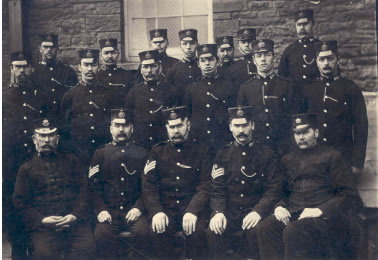
The Glamorgan Constabulary Merthyr Contingent pictured in 1895,
13 years before the creation of a separate police force for Merthyr Tydfil.
In the early days of the development of the iron works, rows of cramped housing had been erected by the iron companies on the fringe of their works to accommodate labourers and their families. As trade prospered and wages increased, workmen were able to afford better housing and abandoned these dingy dwellings with their sulphur laden atmosphere. Eventually this primitive housing was taken over by the undesirable element of Merthyr society, and the immediate environs of the iron works became dens of vice, with the cottages deteriorating into filthy overcrowded hovels.
In the absence of any adequate policing system, these dens grew unchecked, until each had established a community of its own and a zone into which a respectable person could enter only at his peril! Such a place was the district around the famous Iron Bridge erected in 1800 over the river Taff, on the very edge of the Cyfarthfa works, and known as "China." The most powerful bully in "China" dominated and ruled it, acquiring the title of "Emperor." "China" became a noted hiding place for fugitives from justice from far afield. A wanted person could be hidden and protected, for not only was the district free from regular police supervision but its inhabitants would gang together to resist the arrest of any of its inmates or "guests" to rescue him or her from legal custody.
The following extract is taken from a constable's notebook in 1861, when the threat of "China" to law and order had been greatly reduced by the constant efforts of the new policemen over a period of 20 years:
"I went into China and there arrested................but he was taken from me by the mob and I was left senseless."
Two other such dens of inequity were Pontshorehouse (inhabitants of which were known as "Cellarites" from the numerous cellars to be found there) and Caedraw, though neither attained the notoriety of "China."
Superintendent Davies, placed by Napier in charge of the Merthyr policing contingent, was a very experienced man, having served as a Constable and Sergeant in the Metropolitan Police and as a Superintendent for one year in the Essex Constabulary. He knew that with the limited force at his disposal it would be useless to enter into direct conflict with the lawless elements of the town within their own domains except in cases of real necessity. The districts of "China" and "Pontstorehouse Cellars" adjoining the Cyfarthfa and Penydarren Iron Works had to be completely subdued, but this would take years to accomplish and the war against them would have to be one of attrition.
China and Pontshorehouse were not included in the beats to be patrolled by the police, but two policemen were put at night on each of the two beats adjoining them. When it became necessary to make an incursion into these parts, the whole body of the police would take part, most often led by the Superintendent. A special target was made of the leaders of these clans of gangsters, so as to weaken their organisation and to discourage candidates from seeking selection to the appointment of leader.
Superintendent Davies' tactics had a greater impact on criminal life in these areas than might have been expected. In response to the subsequent bombardment of threats, he merely remarked in reply:
"It would be idle for me to pay the least attention to any menaces thrown out by a set of drunken and disorderly fellows, but I and my men are not easily frightened by mere words or idle interference, and I assure them they will not find me or them mere schoolboys' play."
The inhabitants of China and Pontstorehouse responded by assaulting and injuring individual constables on their beats. The police combated this by exacting immediate and full retribution on those responsible. The following incident was reported in a local newspaper of the time:
" We understand that 3 men from the Pontstorehouse Cellars are to appear before the Court on charges arising out of a brutal attack on one of the Merthyr policemen, who was left senseless and badly injured. A strong force of the police, led by Superintendent Davies, together with Sergeant Davies and Sergeant Hume, went immediately into Pontstorehouse and took these men from their homes to answer these charges. We understand that some resistance was met with but it was quickly overcome."
The war went on for many years, but it was only during the early stages that direct challenges were issued and accepted. During the 1840s the police proved their toughness and an ability to hit back hard. By the 1850s it became possible to extend the beat system to the whole town, although it was not until the end of Queen Victoria's reign that it became possible for the district called "China" to be patrolled by one constable.
A turning point in this protracted battle was undoubtedly the failure of "Emperor" John Jones, better known as "Shoni Scubor Fawr," prize fighter and "champion of all Wales" to get the better of Sergeant Evan Davies.
Shoni could have been taken into custody comparatively easily by a posse of police at any time and for good cause, as he was frequently drunk and violent. However instead Shoni was tackled by one police officer and this was probably a successful attempt to discredit the bully.
Another problem faced by the police arose from the cosmopolitan nature of the community and the rivalries which existed between different factions. One writer of the time said,
"The workmen who are perpetually immigrating live together very much in clans, e.g. the Pembrokeshire men in one quarter, the Camarthenshire in another and the same with others such as the Irish and Spanish. This type of clanship makes them impose every obstacle to the detection of offenders who flock to Merthyr from all parts."
The Chief Constable reported in similar vein in June 1942, when referring to the difficulty in getting parties to come forward to give evidence:
"Throughout the County I have traced a species of clanship which renders the Welshman particularly averse to give evidence against a neighbour, even though he should belong to a different County to himself."
Constant bitter fighting occurred between the various colonies. The Welsh were hostile to all invaders, in the main because these newcomers, often close to starvation and used to lower standards of living, offered their labour to colliery owners and iron masters at such low rates that the comparatively good wages secured by local workers after generations of perseverance were jeopardised.
The invasion of workers caused the supply of labour, for the first time, to exceed the demand for it, and local people were forced to accept lower wages in the face of such competition. The Irish were the main enemies as they came in the greatest numbers and were willing to work for very little. People grouped together in view of their common nationality, interests and religion, but also for protection. The following is a newspaper account of a typical Welsh-Irish set to which occurred after the County Police took over at Merthyr. (Similar outbreaks in 1816 and 1831 led to severe rioting that resulted in the intervention of the military).
Dowlais Riots: "On the nights of Saturday, Monday and Tuesday some disturbances occurred in this busy hive of industry. It appears that a very bad feeling has for some time existed on the part of the Welsh workmen towards the Irish, and that it has been caused by the great influx of the latter, whose arrival not only directly leads to a fall in the rate of wages by the increased supply of labourers, but also has other untoward effects by introducing filth, squalor and disease. For the low Irish such as coming here are a remarkably dirty assortment, while nothing can exceed the cleanliness of the Welshman's cottage, or the commendable desire of the Welsh Matron to have everything orderly.
Next, there is no community of interests or sympathies between the two classes. On Saturday night there were several unlicensed houses open for the sale of beer in the locality known as Irish Row, and towards Sunday morning, drunk having produced its usual ill-effects and deprived the parties of the slight intelligence and prudence whith which they are provided, a fight ensued between the Irish and the Welsh, the latter proving victorious.
Maddened by their defeat, the Irish perpetrated a most unwarranted outrage, namely that of breaking the windows of the Welsh Independent Meeting House. This exasperated the Welsh, who assembled on Monday to nearly the extent of 1,000 persons and not withstanding the exhortations of Mr Hughes, its Minister, that they should keep the peace, they commenced an attack on the houses occupied by the Irish people. Windows were broken, window sashes smashed and in some instances the people in the houses assailed were hurt.
Sergeant Plumley of Dowlais did all in his power to keep the peace, and was reinforced by Superintendent Wrenn and a number of officers from Merthyr town, but the officers had great difficulty in preventing further mischief as the Irish were attacked in several places at the same time and the disturbances lasted until one in the morning of Tuesday. On the morning of Tuesday, six men, three Welsh and three Irish, were apprehended and safely lodged in the Station House. On the same day the disturbances re-commenced, but on this occasion, a body of police headed by Superintendent Wrenn, who has proved himself a really efficient officer, cleared the streets and hence no serious mischief occurred, but several large stones were thrown, one of which nearly struck the Superintendent on the head."
Another serious riot took place at Hirwaun:
Riot at Hirwaun:
" Five colliers were charged with riotous assembly at Hirwaun, in the parish of Penderyn, with about 100 others, breaking in the windows and doors of the Golden Lion and assaulting Mrs Stacey, landlady and other inmates. It appears that on Saturday night some Welsh workmen molested some Irish railway excavators as they were going along the road. A row ensued in which two Welshmen got stabbed, one severely.
An Irishman was taken into custody by PC Selway on this charge. There being no lock-up at Hirwaun, the officer had to convey, the prisoner to Aberdare, and during the absence of Selway, the only constable at Hirwaun, the Welsh workmen assembled to the number of about 100 and commenced an attack on the Golden Lion, whose landlord is connected with the railway works. The conduct of the mob was described as outrageous, and lasted from 11.30pm to the early morning. The prisoners were apprehended on Monday morning by Superintendent Wrenn and his officers who came across from Merthyr. The Irishman charged with stabbing said that he would have been killed by the Welshmen if it had not been for the constable."
One Merthyr resident of the 1830s commented that if it had not been for respectable tradesmen acting as petty constables Merthyr would have been in a state of perpetual disorder. Yet added that no parish constable would have dared interrupt a fight between the various neighbourhood clans.
The First Police Stations
The building of the first place of confinement for disorderly persons in Merthyr Tydfil had been commissioned to a Mr Edward Powell on 21st July 1808. The cost was £56 19 shillings, and it became known as the "Dark House." The building was described by Charles Herbert James in his book "Myself and Old Merthyr" as being:
"
about 10 or 14 feet square, no windows to it, no fireplace, a door studded with nails; there men often half drunk, and sometimes very drunk were pushed in and remained there until brought before the Justices."
The "Dark House" was totally inadequate for housing prisoners and was openly mocked by newspapers of the time. One wrote:
"We understand that last week a man committed for trial broke out of what is facetiously called our "lock up" house. This is so common an event now that we should not have noticed it, but for the alarm expressed by some of our neighbours, who think they may be exposed to the immediate vengeance of some desperado against whom they have to testify, but they can set their minds at rest for a committal to our lock up is virtually a discharge as no felon need remain there longer than he pleases, unless he chooses to do so as a point of honour."
The Chief Constable, Captain Napier, was also decidedly unimpressed. He wrote:
"I have inspected the cells at present in use at Merthyr and found them totally unfit for the reception of prisoners, indeed so much so that the magistrates find it necessary to place prisoners at public houses in charge of a constable, at considerable expense to the County....I urge the construction of a station house at Merthyr, not only for placing the men under the eye of the Superintendent, but also for the security of the prisoners. The dampness of the present cells render them totally unfit for the reception of prisoners, besides which they are so extensively insecure that I have been compelled to place a constable on duty to interrupt spirits being brought in by friends of the prisoners, as well as to prevent the latter making their escape."
When the cells became unfit for use, prisoners and a constable were housed in a nearby public house. The "Dark House" later became two cottages, 19 and 20 Cross Keys Street, each consisting of one room upstairs and downstairs, rented at 5 shillings each per week. Sadly all the properties in Cross Keys Street were demolished in the late 1950s.
To mark the formation of the Glamorgan County Police Force, it was necessary to build the first police station at Merthyr Tydfil in 1844 in Graham Street in the centre of the town. The station was not without its problems. Firstly, its foundations were undermined by the well supplying it with water, and secondly, the benches used by the prisoners to sleep on were too narrow and condemned by the Home Office. A station was built at Dowlais in 1862 and in 1898 at Merthyr Vale.
An Inspector was placed in charge at each of the three main stations, residing there with his family, alongside unmarried constables. Single constables were subject to stringent restrictions on their private lives. Whilst off duty, they were not even allowed to leave the premises or even to purchase food for their own consumption, without prior permission from a senior officer, as they may have been required for extra duties. Constables were also required to say where they would be available on official rest days or annual leave. No one was allowed to leave the Borough without a written request to the Chief Constable, and permission had to be requested to even get married!
A married officer living in a main station, provided by the Borough Council, had 2s 6d deducted from his wages for living accommodation, and a single constable 1s 2d. A single constable living in a cottage station had 6d per week deducted. Sickness resulted in the deduction of 1s per day from a constable's pay.
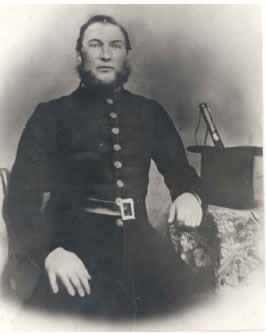
Moses Row, A Merthyr Constable pictured in 1862.
Cottage stations were situated throughout the Borough of Merthyr Tydfil and the area each covered known as a "beat."
Captain Napier described the beat system in Merthyr as follows:
"One Sergeant and five Constables are set on night duty every night at 9pm and remain out until 5am. Before retiring the men who have come off duty clean the station. In addition the two day Sergeants patrol alternatively as Inspectors during the night to see that all duties are performed. The whole of the town is traversed during the night by these two Sergeants. The Sergeant who has the early night patrol goes to bed at one, and is out again at six, while the other patrols from one to six and is expected to be clean and ready for duty at 10am, at which hour two Sergeants and one Constable must be ready for day duty and to attend to magistrates' meetings. All summonses and warrants have to be served by the men on day duty. Should any of the constables have cases for petty sessions, they too must be ready by 10am for inspection. The Sergeants for night duty and the Constable for day duty are changed regularly, so that all may be served alike. The town is divided into 4 beats, beats numbered 3 and 4 being patrolled by two Constables together owing to the disorderly state of these parts of the town."
Life in the main and cottage stations lacked comfort. In 1909, Dowlais station had a case of enteric fever resulting from the insanitary conditions of the men's lavatories. The boiler at Merthyr Vale station, described as being in a "very dismal room or cellar" broke during the Christmas of 1938 leaving Inspector Young and his family without hot water. During the previous year a request had been made for a telephone extension to be installed in the kitchen, as in the absence of anyone available in the station, the Inspector's wife had to climb 20 steps to answer the telephone!
In 1936, the single constables at Central Police Station had no facilities for drying their uniforms, and a room adjoining the cells was converted for this purpose. In 1931, Penydarren cottage station was in such a dilipidated condition that the Sergeant could only use one room in the house for police and living accommodation.
The wives of policemen who resided at police stations were required to search female prisoners. In 1909, Mrs Maud Phillips, wife of Inspector A J Phillips, officer in charge of the Central Police Station accepted the position of Police Matron at a salary of £20 per annum. During this period of history, more women were arrested in Merthyr than any Borough of its size in the County. All female prisoners had to be searched and the matron had to provide a special servant for this purpose. Most of these prisoners were prostitutes. Wives of officers in charge of Dowlais, Merthyr Vale and Treharris Stations were paid 1s 0d for every prisoner they searched and attended to.
A New Police Force For Merthyr
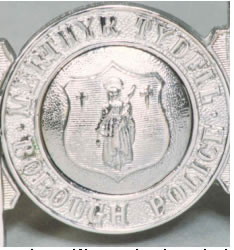
Merthyr Tydfil Borough Police belt showing Saint Tydfil, the Force's emblem.
The Merthyr Tydfil Borough Police Force was established on Wednesday 30th September 1908. The day was marked with controversy, as Glamorgan County Council wished to retain the Central Police Station at Merthyr because of the court facilities there, and also the police station at Treharris, the latter being in close proximity to the Glamorgan Police District. Glamorgan Council were however prepared to relinquish the stations at Dowlais and Merthyr Vale and all the cottage stations.
The "Merthyr Express" of the 4th October 1958, reports that at the time of the signing in ceremony of the new force, all the Borough Police Stations were still the property of the County, and that the charge room only could be used by the new police!
Notices to quit were served on 30 Merthyr constables stationed at Graham Street Police Station and the County Police in the Borough were called to occupy the vacated accommodation. Many locals gathered to enjoy the fun, but later that day all was resolved when the documents transferring the police stations within the Borough to the Merthyr Tydfil Borough Police Force were sealed after the leases were signed.
Inspector J A Wilson of the Glamorgan Police Force was appointed Chief Constable of the new borough police force, and commenced his duties on Saturday 15th August 1908, at a salary of £250 per annum.
Many men from the Glamorganshire Constabulary also transferred to the new force. They were given one month to chose which force they wanted to continue their service with. New recruits had to be under 27 years of age, a minimum height of 5ft 11ins, a minimum chest measurement of 36 ins and received 26 shillings per week.
Local residents do not appear to have applied to or been accepted into the new Merthyr Force, but there were appointments from men residing in Newport, Llanelly and Carmarthenshire. It is unknown whether this was through the choice of the Chief Constable or down to the abundance of work in the heavily industrialised town. The pursuance of a Career in the police force appeared to be very much a family tradition and this continued throughout the existence of Merthyr Borough Police. When policewomen were recruited in the late 1940s one was a daughter of a police sergeant and another 2 had brothers already serving at Merthyr.
The following items of clothing were provided to each constable:
First Year:
1 Great Coat
1 Cape
1 Tunic
2 Pairs of Trousers
1 Helmet
1 Pair of Leggings
1 Pair of White Gloves
1 Pair of Black Gloves
Second Year:
1 Serge Jacket
1 Cap
1 Pair of Trousers
1 Pair of White Gloves
1 Pair of Black Gloves
All ranks received 6d a week in lieu of boots. The helmet insignia and buttons bore the Borough Seal, designed by Sir Goscomb John, and show St Tydfil holding a distaff to signify industry, whilst her martyrdom is indicated by a dagger on each side of her head.
The new Borough Police Force began with 75 members:
1 Chief Constable
3 Inspectors
9 Sergeants (including one detective sergeant)
4 Acting Sergeants
58 Constables (including one detective constable)
An additional 10 men were paid for by private companies:
4 Sergeants
1 Acting Sergeant
5 Constables
Private companies paid for security at Cyfarthfa Works, Dowlais Works and the collieries in the area, so they bore the full cost of pay and uniform. When one of these companies ceased to function, the extra men employed by them returned to normal police duties. If there was no corresponding rank in the Borough Force, a police officer would be demoted. Private companies made their own arrangements with the policemen employed by them regarding their hours of duty.
The Borough Police worked 8 hours a day, and the men in the cottage stations worked 10 hours. In the early years of the force, the police worked 7 days a week. Annual leave was not allowed to exceed 21 days a year. Seven of these days were taken at such times applied for and granted by the Chief Constable, depending on circumstances.
The cost of putting into operation the Police Weekly Rest Day Act of 1910, whereby every police officer was entitled to one days rest in every seven, meant that an extra 10 men had to be recruited at a cost of £808 3s 9d. To save money, the decision was taken to appoint a further 6 men at a total cost of £440, and to defer the appointment of the remaining constables.
Manning The Fire Brigade
Merthyr Constables were also responsible for fire duties. The first equipment available for use was an obsolete hand-drawn Manual Engine coupled with 2 hose-carts. When a fire did occur precious time was lost in collecting the required equipment and connecting the hoses. Chief Constable Wilson, as Chief of the Fire Brigade, recommended that a new motor fire engine was purchased costing £920. It was manned by 12 full-time men who resided in or near the Central Police Station, and supported by the remaining members of the police who acted as Auxiliary Firemen and were paid 1s 0d per drill, with a maximum payment of 12s 0d per annum, in addition to their wages. The fulltime police/firemen were paid 2s 0d a week.
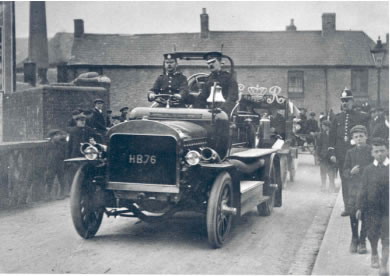
Merthyr Tydfil's new fire engine, introduced in 1911.
In 1924 the Secretary of State argued that the police force should not be utilised for fire duty, and a separate Fire Brigade should be established instead. However the police continued to man the Fire Brigade until August 1941 when all fire brigades were formed into the National Fire Service, and the transfer of some policemen into that service became necessary as they had the knowledge to operate the machinery.
In 1932, after 21 years service, the old Morris fire engine was sold to an Abergavenny farmer for £13 5s 0d and was replaced by a Leyland Motors vehicle costing £927 10s 0d with a maximum output of 400 gallons per minute. This new fire engine would prove invaluable to assist in the emergencies arising from the "Blitz" at Cardiff and Swansea during the 1939-1945 War.
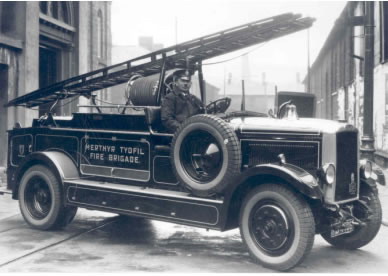
The Leyland Motors Fire Engine, pictured in 1932.
Transport
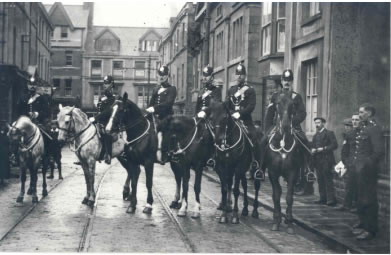
Merthyr Borough Police on horseback in Merthyr High Street.
Merthyr Police did not own any horses, although some were hired for drill purposes at 2s 6d per drill. The owner however was responsible for any injury to the horse. Mounted police were used for special duties and crowd control during parades in the Borough.
Police Sergeant Percy Botting, a reputedly fine horseman, was the driver of the Police Prison Van or Black Maria, used for the first time in 1909. A local man supplied the horses on 3 days a week for 15 shillings. The Van was eventually sold in 1924 for £10. It was replaced by a Van/Ambulance costing £318 and a table of charges was drawn up for the use of the ambulance by the general public. It appears to have been the only van available in Merthyr during this time. After the sale of the Van/Ambulance in 1936, a Bedford van was adapted for police use and then in 1937, the Secretary of State approved two 8hp cars for motor patrol purposes as the motor-cycle combination and solo machine were worn out. Two new 1938 model Ford motor cars were purchased at £117 10s each.
In 1916, Chief Constable J A Wilson was allowed £50 per annum towards the upkeep of a car he had purchased himself, to enable him to visit different parts of the Borough and attend fires as he was also responsible for the Fire Brigade.
Ten years later in 1926, PC 60 Richard Evans purchased his own motorcycle and was given an allowance of 10 shillings to carry out his duties as a motor cycle patrol. This record was the first to indicate that motor cycles were in police use.
In 1931 the Merthyr Watch Committee made the decision to purchase one motorcycle with a side-car combination and one solo machine in order to enforce the Road Traffic Act 1930.
Mutual Aid
From the years 1910 until the end of the First World War, Merthyr Borough Police were instrumental in assisting other local forces with their troubles.
In 1910 two sergeants and 22 constables were sent to Aberdare, in response to an urgent telephone request by Lionel Lindsay of the Glamorganshire Constabulary to support Glamorgan with the coal strike there. All leave was cancelled so 50% of the allowance of 2s 6d per day paid to the constables in the strike area was divided between the men remaining in the Borough, who had worked overtime. The Merthyr Independent Labour Party disagreed with this policy of mutual assistance, arguing that if the police could be spared in this way, steps could be taken to reduce their number and alleviate the burden on the taxpayer.
Merthyr subsequently kept out of policing the coal riots and lent its officers elsewhere instead, with the Chief Inspector, 2 Sergeants and 27 Constables assisting the Cardiff City Force with the Cardiff Seaman’s Strike of 1911.
During the First World War, 54 Merthyr Police Officers saw action, with 6 of them losing their lives – Tom Evans, Walter Stubbs, Tom Clarke, T Voyle Morgan, Reginald Lovis and Alfred Leonard. Two of those who lost limbs, PC A V Leonard who lost his left arm below the elbow and PC F Fry who lost a leg, remained in the Force on clerical duties. All the men who served in the war were required to return their uniforms to the police force and these were then re-issued, a practice which continued throughout the existence of Merthyr Borough Police.
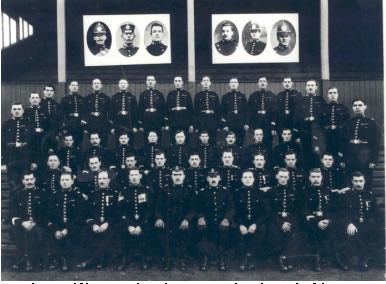
Merthyr Tydfil Borough Police pictured at the end of the First World War.
The banners show the faces of the 6 police officers who were killed in action.
There is little doubt that eliminating waste was essential to the survival of the Force, something which was particularly evident in 1937 when Merthyr was the highest rated Borough in Britain
Effective Discipline - The Key To Merthyr Police's Success
The history of Merthyr Tydfil Borough Force tells the fortunes of Merthyr Town itself, from when it was a "boom town" in 1908, requiring its own police force, to the years of depression in the 1930s with rates at 27/6d in the pound and the police having to take a reduction in their salaries.
The comparison in crimes committed in 1937 as opposed to 1908 also shed light on the economic blight. Prostitution and drunkenness were the main causes of arrest in 1908, with these offences dwindling dramatically by 1937 (just 68 offences from 1,106) with thousands of men surviving on dole or parish relief. The war waged by Chief Constable James Arthur Wilson to close "objectionable" licensed premises in the town further contributed to this decrease.
Wilson was also very much the disciplinarian within his own Force. In 1909 a police constable was dismissed for being guilty of conduct prejudicial to the good rule and discipline of the Force, and 2 others for serious breach of discipline and for being absent from duty without leave.
Authority and discipline lay at the heart of successful policing within Merthyr. When Chief Constable, David Morgan Davies, dealt with the coal strikes of 1921 and 1926 and the closing of the Guest Keen and Baldwin Works at Dowlais, it was said that "that absence of disorder was officially attributed to the firm and tactful way in which the police under him handled and controlled the crowds."
Wilson also presided over the first successful murder investigation by Merthyr Borough Police. The murder took place on Christmas Eve 1908 when a local prostitute, Mary Ann Rees, was thrown down the shaft of a disused coke oven at the Ynysfach Works site by her pimp, William James Foy. Foy was later hanged at Swansea Prison at 3am on Saturday 8th May 1909.
The Battle For Police Recruits
Police officers recruited during the years prior to the depression often had experience in HM Forces either as short-term regulars or had been servicemen during the First World War. Men with technical experience were also employed to maintain the motorcycles, fire engine and motor cars.
This situation changed in the 1930s with the shortage of employment leading to grammar school educated young men becoming attracted to police duties for the first time, and competing for the few opportunities available in this era of limited recruitment.
After the industrial survey by Lord Portal in 1934 the Special Areas Act was passed, and a proliferation of light industrial work came to Merthyr. Recruitment to the police once again became possible with local well-educated young men applying to become constables.
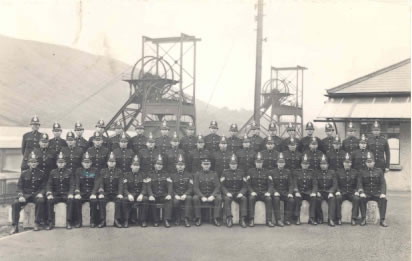
Merthyr Borough Police, pictured in 1935.
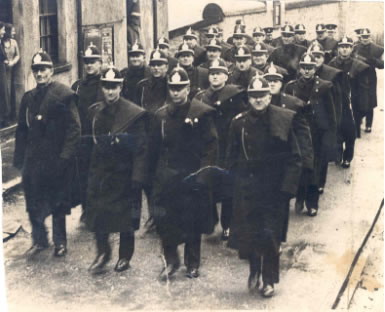
Merthyr Police pictured in 1937 on the occasion of their inspection by
Colonel Allan HM, Inspector of Constabulary.
The Second World War resulted in a greater respect for the police and the work they did. The Police Post-War Committee realised the necessity of making a police career more attractive in order to be able to recruit the best people in an increasingly competitive market place. They recommended the introduction of a training establishment to enable serving police officers to fill the higher posts in the Police Service, in a bid to introduce a climate of opportunity into the police force. The Police College was duly formed in 1948.
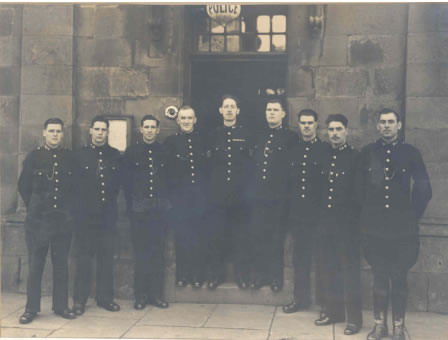
Merthyr Tydfil Borough Police (Sergeant Jack Cummings’ Shift) pictured in
August 1942.
From left to right in the above picture are PCs Bob Davies, Selby Star, Selwyn Miller (War Reserve), Aneurin Rasbridge (War Reserve), Sgt J Cummings, Ted Williams, Jack Powell, Bill Charles, Llew Bridges
In 1947 the Desborough Report, which created the basis for conditions of service in British Police forces after the first world war, despite the excellence of its survey and assessment of what was needed to ensure efficiency and contentment, was found inadequate to meet the needs of its era. Parliament, in appointing the committee under Lord Oaksey’s chairmanship, called for a fresh survey and for recommendations to restore vigour to the service that was essential for its future efficiency. Certainly radical changes were needed to halt the shrinkage in police manpower and restore a healthy balance of recruitment.
Although Merthyr Police had fared better than most police authorities in attracting recruits, there had been a decline in the number of candidates applying for entry.
The principal effect of the changes issued from the Report was the increase in pay of all ranks in the Police Service, however this did not lead to any marked improvement in the quality of candidates applying to Merthyr Police. It did though result in an approximate increase in yearly applications from 5 to 11 people. Additionally, upwards of 10 men were examined in Merthyr for recruitment to Worcester Constabulary.
The Force at Breaking Point
The year 1950 reflected a Force in crisis. 1950 was remarkable for the incidence of prolonged sickness amongst the senior officers of the Force together with an increasingly upward trend in criminal offences. Major problems included pilfering from the new light industries that had sprung up in Merthyr – an illegal practice that had previously taken place in the mining industry, and a rise in violent offences. In a bid to counteract these problems "team policing" which aimed to increase the mobility and concentration of personnel for specific tasks (preventative or detective) and provide a measure of relief from the monotony of ordinary beat working, were introduced with great success and the year 1953 showed the lowest crime figures since the end of the war.
However, this merely proved the lull before the storm. 1954 showed an easing in the flow of suitable candidates for recruitment and a dramatic increase in the number of assaults made upon the police from just 4 cases in 1953 to 23 in 1954. In a district that prized its reputation for good conduct, this record constituted a challenge.
Additionally, the decision of the Police Council in 1955 to award an extra day’s leave per fortnight to all members of the Police Service of and below the rank of Inspector, introduced to provide a degree of parity with general industrial conditions, led to considerable staffing difficulties.
The Police Council’s decision was timely though as the need to maintain conditions of service had now become crucial to Merthyr Police. Where once the Force had bucked the national trend, now the flow of candidates had become merely a trickle. It was a tribute to the Force then that in the face of such difficulties 11 members of the Force received recommendations (a ratio of 1 in 11 police officers) in 1955 and the Chief Constable was awarded the Queen’s Police Medal for Distinguished Service in the Birthday Honours List.
In April 1956, the crisis of recruitment and staffing was again addressed, this time through the increase in the authorised establishment of Merthyr Police of 1 Inspector, 1 Sergeant and 8 Constables. The new overall establishment of men totalled 114 and was met by an actual establishment of 100. The authorised establishment of policewomen in contrast numbered just 3, with actual strength standing at 2.
Aside from the staffing increase, Merthyr Police explored other means of increasing policing cover. Police officers were trained by the Traffic Department on how to ride and maintain a motorcycle, and patrols were established under the School Crossing Patrols Act of 1953 to relieve pressure on policing strength by supplementing the manpower available to take care of children going to and from schools.
In 1957 the experiment of amplifying beat coverage by the employment of light motor cycles was extended so that by May 14 constables had been trained and put into operation in pairs on 7 light motor cycles to give much needed policing cover to the expanded residential areas. The resulting variation in duties for beat constables afforded by the motor cycles had a positive affect on recruitment, encouraging 7 men of a suitably high standard to apply and be accepted into Merthyr Police. The increased mobility of the Force was also invaluable in meeting the extra burden caused by the extraordinary increase in crime during the year of a staggering 41%.
The total number of crimes rose from 533 in 1956 to 709 in 1957 – the highest on record. The most ominous increase was in crimes of "Breaking and Entering" which rose from 115 cases in 1956 to 202 cases in 1957 (an increase of 75% and nearly 200% on 1955). Further increases in crime followed in 1958 with 808 offences, but dropped slightly to 742 in 1959.
In the complex and rapidly changing living conditions and social habits of Merthyr, most notably the demolishing of sub-standard housing and its replacement with the new council housing estates, communications became the vital means for maintaining contact between the public and the police. The introduction of "999"on 25th April 1959 and the equipping of the new "L E Silent Velocette" motor cycles with wireless served to further enhance relations between the two without becoming a substitute for personal exchanges.
Despite these innovative approaches however, the crime figures for 1960 escalated. Compared with the year 1959 which showed a slight decrease, crime statistics for 1960 rose by a staggering 42% whilst offences of breaking into houses and shops doubled. 1,060 crimes were reported as opposed to 742 in 1959. Nor were these sobering figures the whole story. The first factor was that the high crime rate of 1960 was superimposed on the higher plateau of crime of the past 5 years and secondly the figure for larceny was not a true reflection – only one crime was recorded when a person was detected in a series of thefts, frauds or embezzlements. Were it not for this reduction the crime figures would be much higher.
Worryingly, serious offences committed by juveniles was also on the increase, and at a rate higher than the national average.
On a more positive note, detection by Merthyr officers rose to 52.7% (from 46.3%), and reflected the excellent efforts made by the force to stem a rising tide of serious crime. Officers also made special efforts in the field of crime prevention for the first time, recognising that a proactive strategy aimed at raising public awareness of house and shop breaking would result in reduced opportunities for thieves.
This fresh approach at Merthyr resulted in every constable becoming the immediate agent of crime prevention in contact with the public.
1961 again showed an increase in the crime rate in Merthyr, but not as drastic as the figures for 1960 (an increase of 10% as opposed to 42%). Detection rates also rose to meet the challenge (56.6% of all crimes). During the years from 1950 to 1960 communications at Merthyr Tydfil had doubled. First wireless was added to motor cycles, then Telex (typewritten messages over telephone lines) and now burglar alarm systems were introduced – without such efficient systems of communication the operational effect of the police force would have been halved.
Pre-occupation with crime however did have the effect of reducing the availability of men for other duties, including traffic duties and patrolling the outer districts of Merthyr town.
The Rise of The 'Travelling Criminal'
1962 appeared to be a turning point in the fight against crime, with a stabilisation in the crime statistics.
Interestingly this year, Merthyr Police found that 10% of serious crimes committed within Merthyr Tydfil were carried out by criminals living within a 15 mile radius of Merthyr Town Centre, and a further 9% from beyond that radius. It would seem that the increased use of motor vehicles during this era allowed criminals to operate at considerable distances from their homes. Significantly those criminals who came from furthest away were generally involved in more serious crimes.
The problem of contending with the unknown "travelling criminal" led to practical measures of co-operation on the part of all neighbouring forces, with senior detectives meeting regularly to compare views and experiences. These conferences bore fruit in 1962 for all the police forces participating.
It was somewhat disappointing therefore that in 1963, figures for reported crimes again rose steeply by 18.73% on 1962 figures.
An Increase in Establishment
In order to meet the need for additional manpower following the introduction of the 42-hour week , coupled with a re-organisation of the Force which was introduced on the 1st November 1964, the establishment of the Force was increased as from the 1st October 1964 by 1 Chief Inspector, 6 Sergeants and 14 Constables. This included 1 Woman Sergeant and 2 Women Constables.
Recruitment of women to the Force was further boosted by the decision to increase the number of general purpose motor cars. This ensured that women officers could spend more time on patrol in areas such as Dowlais, Treharris, Merthyr Vale and Aberfan. Women’s development was also encouraged with opportunities for them to gain experience within the Criminal Investigation Department, and attend courses on subjects such as "Dangerous Drugs."
The Force’s continuing commitment to Crime Prevention resulted in the establishment of a Crime Prevention Department on 1st June 1964. One of the first measures adopted was to introduce a system for recording and standardisation within the Force of crime prevention advice given and action taken in relation to certain indictable crimes and other incidents. The aim being to encourage all officers to take an active part in crime prevention activities and to improve their knowledge of crime prevention techniques.
Despite the diligence and attention given to crime prevention methods, and the fact that the age of criminal responsibility was raised to 10 years, crime statistics again showed an increase by 15.40% (1626 recorded crimes) on the figure for 1963. Of the crimes recorded 47.54% were detected, a decrease from 54.79% the previous year.
Some progress though was made in 1965 when the number of crimes reported was contained to a small increase of 28 as opposed to the considerable increases of the previous few years. A containment which continued for the years 1966 and 1967 as the intensive efforts of the Crime Prevention Department began to bear fruit.
During the Force’s final year of operation, its new Headquarters became operational at Swan Street in Merthyr Tydfil on 3rd November. This was followed by the new police station at Dowlais on 9th December and the eagerly awaited reconstruction of Treharris Police Station. The high standard of police accommodation proved an asset to the amalgamation process and confirmed the commitment made by Merthyr Police, 83% of which was staffed by people native to the Merthyr area, to provide the best possible service to the local community.
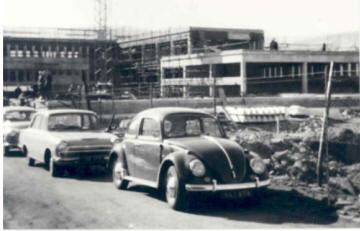
The new Merthyr Tydfil Police Headquarters under construction.
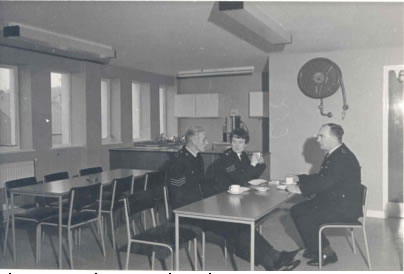
Inside the Canteen, at the new Merthyr Police Headquarters.
The Force had performed admirably over the 61 years of its history, firstly striving to establish itself against a background of industrialisation and a rapidly expanding population, then battling tirelessly against rising national and localised crime in the post-war years.
Merthyr Borough Police ceased to exist on 1st June 1969 with the amalgamation of the Glamorgan, Neath, Cardiff, Swansea and Merthyr Forces. Merthyr Police subsequently became part of the new South Wales Constabulary.
Used with kind permission from the South Wales Police Museum.